Why Golfers get lower back pain – And how to prevent it
Posted on August 17th, 2026 by Andries Lodder
by Crystal Quaite
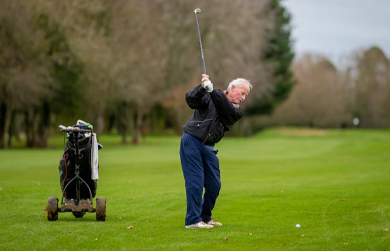
Golf may appear to be a low-impact sport, but it places significant physical demands on the body. However, a single round involves walking several kilometres and performing hundreds of rotational movements. The golf swing is a highly technical and powerful movement that requires mobility, stability, coordination, and strength. With that being said, without proper conditioning, these repetitive forces can lead to pain, reduced performance, and injury.
The Biomechanics of the Golf Swing
The golf swing is a complex sequence of movements involving:
- Trunk rotation
- Hip dissociation
- Shoulder mobility
- Core stability
- Weight transfer and balance
To generate efficient power in golf, a kinetic chain is followed that begins from the ground, transferring through the legs and hips, moving through the trunk, and finishing in the upper limbs. If one link in this chain is weak or restricted, it results in other areas compensating. This compensation often leads to overuse injuries such as lower back pain.
Lower back pain is particularly common due to repeated rotational stress, combined with limited hip mobility or poor core stability. If the hips cannot rotate effectively, the lumbar spine will then absorb excessive torque. Overtime this will increase strain and injury risk.
Mobility + Stability = Performance
Many golfers focus only on technique and equipment, but neglect physical preparation. Optimal golf performance requires a balance between mobility and stability.
Key areas that require mobility:
- Thoracic spine rotation
- Hip internal and external rotation
- Shoulder mobility
Key areas that require stability:
- Core musculature
- Gluteal muscles
- Scapular stabilizers
Strength Training for Golfers
Strength training enhances power output and endurance.
A golf-specific exercise program should include:
- Rotational strength exercises
- Anti-rotational core stability
- Single-leg strength training
- Posterior chain strengthening
- Balance and proprioceptive work
This improves control during the swing and reduces fatigue over 18 holes.
Prevention Is Better Than Rehabilitation
Many golfers only seek help once pain develops. However, movement screening and corrective exercise can identify limitations before they become injuries.
Addressing muscle imbalances, asymmetries, and joint restrictions early helps maintain longevity in the sport.
Golf is a lifelong game therefore the goal should not just be about performance but, but durability.
Move Better. Play Better.
Golf performance is not determined by technique alone. The body must be capable of executing the demands placed upon it.
Through structured exercise therapy and movement optimisation, golfers can:
- Play pain-free
- Improve their swing mechanics
- Increase distance and control
- Extend their playing years
Investing in your physical preparation is investing in your game. Contact us to help improve your mobility and lower back aches and pains.
Tweet