Improve Your Golf Performance
Posted on September 2nd, 2026 by Andries Lodder
by Adding Distance To Your Drive
Jana van Jaarsveld

The Major Goal for many golfers is to add distance to their swing. While equipment, technique, clubhead, and speed all a roll plays, is physical performance often an overlooked part.
if you want to hit the ball further your goal shoulder be simply to hit the ball harder. it is about developing the physical qualities that allow you to generate more force, create greater clubhead speed and transfer that energy efficiently through the golf swing.
Where Does Distance Come From?
Driving distance is influenced by several factors, including:
- Clubhead speed
- Quality of contact
- Launch angle and spin
- Technique and swing mechanics
- Strength and power
- Mobility
- Stability and control
From a physical-performance perspective, improving your strength, power, mobility and ability to transfer force can help you create a more efficient and powerful swing.
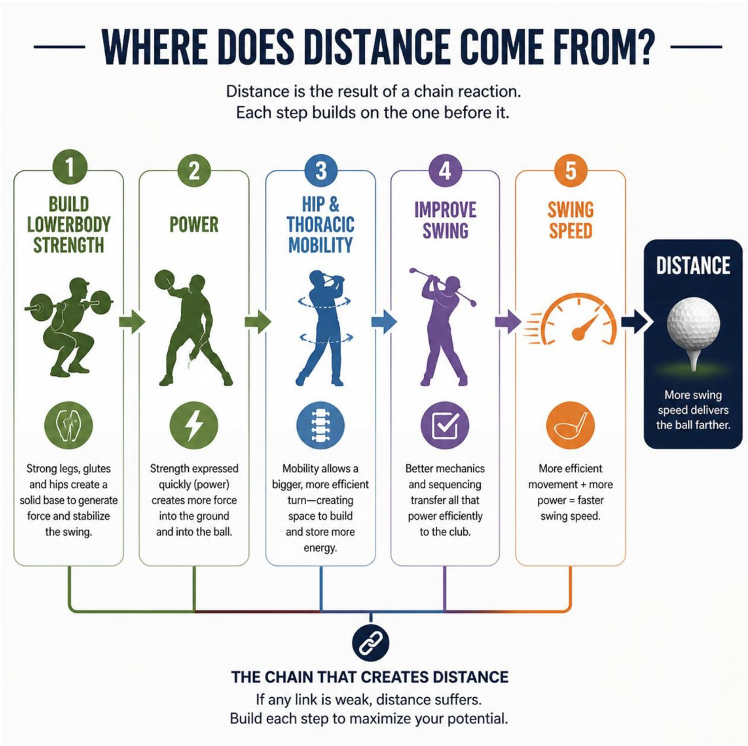
1. Build Lower-Body Strength
The golf swing starts from the ground.
Your legs and hips provide an important foundation for producing force and transferring it through the body. Stronger glutes, hamstrings and quadriceps can help you create a more powerful ground-up movement.
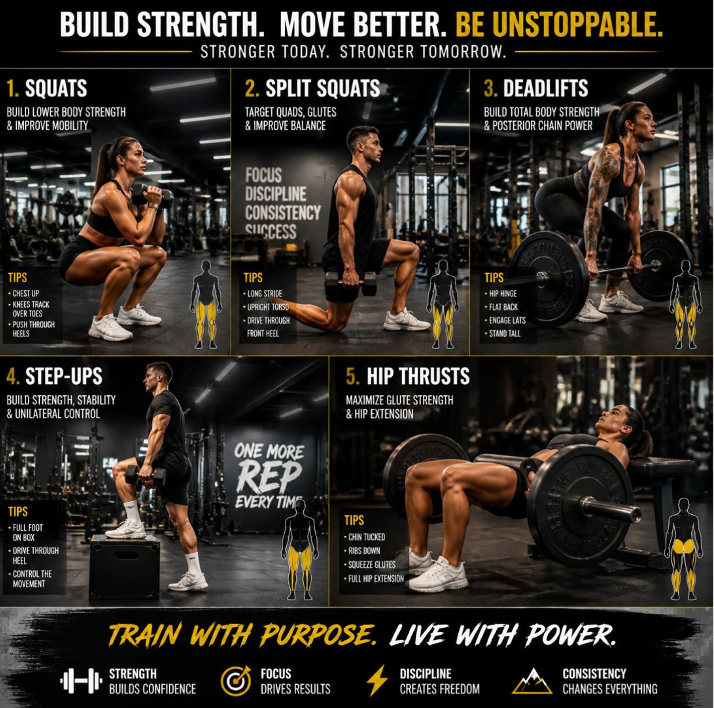
Exercises such as:
- Squats
- Split squats
- Deadlifts
- Step-ups
- Hip thrusts
can help develop the strength required for a powerful golf swing. However, strength alone isn’t enough. Golfers also need to learn how to use that strength quickly.
2. Develop Explosive Power
Power is the ability to produce force quickly.
This is particularly important in golf because the downswing happens extremely rapidly. You may have plenty of strength, but if you cannot apply that force quickly and efficiently, it may not translate into greater clubhead speed.
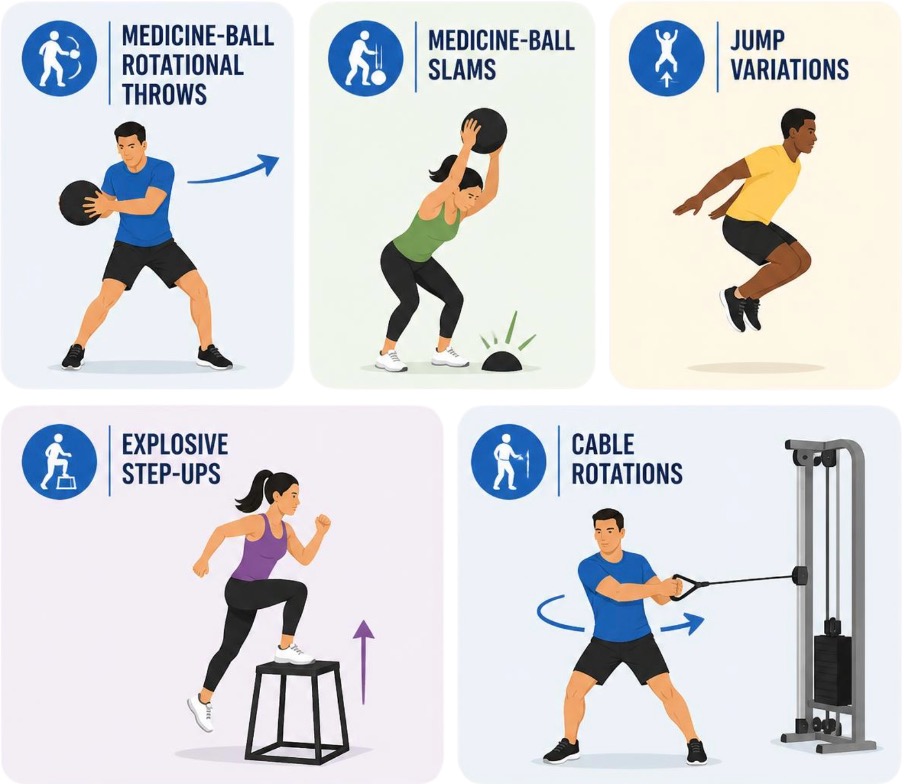
Power exercises can include:
- Medicine-ball rotational throws
- Medicine-ball slams
- Jump variations
- Explosive step-ups
- Cable rotations
These exercises can help train the body to produce force rapidly while working through movements that have similarities to the demands of the golf swing.
3. Improve Hip and Thoracic Mobility
A good golf swing requires adequate rotation through the hips and upper back.
Limited mobility can affect your ability to rotate during the backswing and downswing, potentially resulting in compensatory movements elsewhere in the body.
Mobility work should focus on areas such as:
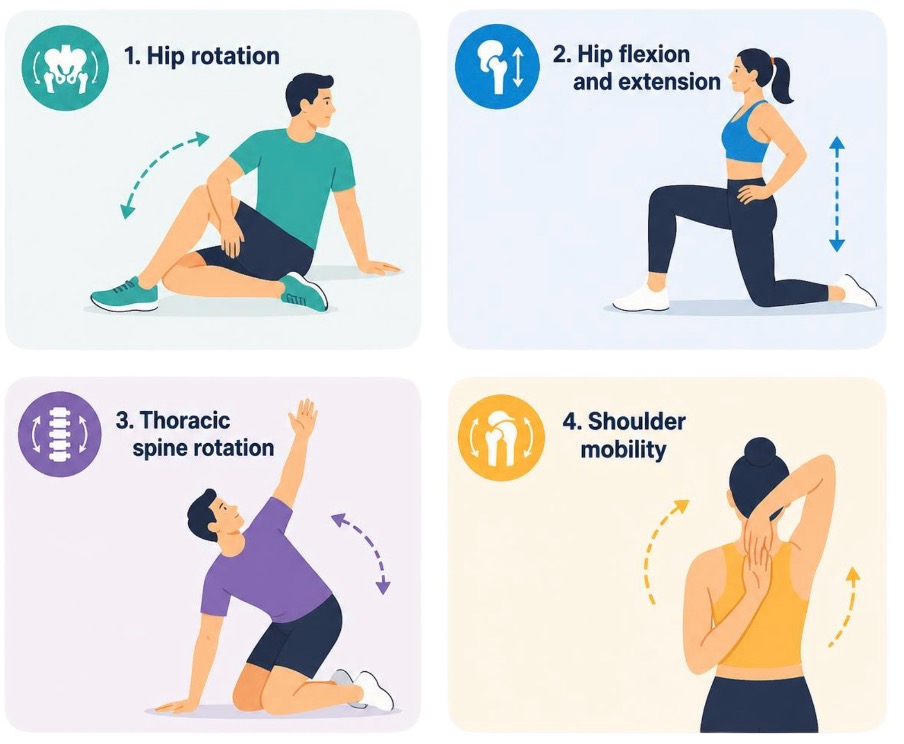
- Hip rotation
- Hip flexion and extension
- Thoracic spine rotation
- Shoulder mobility
The goal isn’t simply to become more flexible. It is to have enough usable mobility to get into the positions required for an efficient swing while maintaining control.
4. Don’t Forget Your Core
Golf is a rotational sport, but simply performing lots of rotational exercises isn’t necessarily the answer.
Good rotational training should develop your ability to:
Create force → control force → transfer force.
This means training both the muscles that produce rotation and the muscles that help you resist unwanted movement. Exercises such as medicine-ball throws and cable rotations can be combined with anti-rotation exercises to develop both power and control.
6. Improve Your Swing Speed Gradually
If your goal is to increase clubhead speed, your body needs to be prepared for the demands of moving faster.
Jumping straight into maximum-effort swings or speed training without adequate strength, mobility and control can increase your risk of overloading the body.
A better approach is to progressively develop:
Mobility → Stability → Strength → Power → Speed
This gives your body the physical foundation required to handle higher levels of performance.
Distance Isn’t Just About Strength
One of the biggest misconceptions in golf performance is that stronger automatically means longer.
Strength is an important foundation, but distance comes from the combination of force, speed, technique and efficient energy transfer.
A golfer who can produce a lot of force but cannot transfer it efficiently may not hit the ball as far as a golfer who produces slightly less force but has excellent sequencing and timing.
This is why golf performance training should complement (not replace) technical coaching.
A Better Approach to Adding Distance
If you want to add distance to your drive, consider looking beyond the golf club and assessing your physical performance.
A golf-specific assessment can identify areas such as:
- Mobility restrictions
- Strength deficits
- Lower-body power
- Rotational power
- Balance and stability
- Core control
- Movement asymmetries
From there, a targeted exercise programme can be developed around your individual needs and golfing goals.
The Bottom Line
Don’t try to hit the ball further by simply swinging harder.
Build the physical qualities that allow you to swing faster and more efficiently.
Develop your strength, mobility, stability, rotational power and speed, then combine these qualities with good golf technique.
The result? A stronger, more efficient body that is better prepared to produce the clubhead speed needed to add distance to your drive.
Want to improve your golf performance?
Speak to a Biokineticist about a golf-specific assessment and performance programme designed around your individual needs.
Tweet